ENGLISH
  Arabic
 Persian

For investors weighing a second citizenship in 2026, the St Kitts passport continues to sit at the top of almost every shortlist. The country runs the oldest citizenship by investment programme in the world, launched in 1984, and decades of refinement have made it one of the most trusted and efficient routes to a second nationality. While newer programmes compete on price and marketing, St. Kitts and Nevis competes on something harder to replicate: a track record. Here is why it still earns the “gold standard” label this year.
A passport built on the world’s longest CBI track record
Longevity matters in this industry. The St. Kitts and Nevis programme has operated continuously since 1984, giving it more than forty years of institutional experience, established legislation, and recognition from governments and financial institutions worldwide. For an applicant, that history translates into predictability. The processes are honed, the legal framework is clear, and the government’s Citizenship by Investment Unit is known for working without the delays that can plague younger programmes. In a market where several programmes have been suspended or overhauled in recent years, that stability is a genuine differentiator.
Strong global mobility
The core appeal of the St Kitts passport is freedom of movement. As of 2026 it provides visa-free or visa-on-arrival access to a large share of the world, including the Schengen Area, the United Kingdom, Singapore, and Hong Kong. Published counts of visa-free destinations vary by source and change over time, so the practical takeaway is this: a St. Kitts passport opens most of the destinations a globally mobile family or business owner actually travels to, and the list has trended upward rather than shrinking.
For many holders, the ability to add a second travel document as a backstop against geopolitical uncertainty or sudden regulatory changes is as valuable as the destinations themselves.
Tax and business advantages
St. Kitts and Nevis levies no personal income tax, no capital gains tax, no inheritance tax, and no wealth tax. Citizens can register companies locally, structure their affairs efficiently, and there is no requirement to live in the country before or after naturalisation. For entrepreneurs and internationally mobile families, that combination — mobility, no residency requirement, and a favourable tax environment — is the practical core of the programme’s appeal.
What the investment actually requires
St. Kitts and Nevis offers more than one route to citizenship. The most common options are:
- A non-refundable contribution to the country’s federal fund, with a minimum around $250,000 for a single applicant or a qualifying family.
- An approved real estate investment, which can generate rental yield of roughly 3–5% per year depending on the property and management.
.
Processing time: One of the fastest routes to a second passport
St. Kitts and Nevis is consistently among the quickest citizenship-by-investment programmes. Standard processing typically runs a few months, and an accelerated due-diligence option can shorten that further for applicants who need to move faster. Compared with programmes that can take eight to ten months or longer, this speed is a meaningful advantage for anyone building a time-sensitive Plan B.
The 2026 biometric update you should know about
The one substantive change this year is the National Biometric Enrolment and Passport Modernisation Programme, launched in April 2026. New applicants now provide a digital facial image and fingerprints as part of the process, with approved collection centres operating in St. Kitts and Nevis and in overseas locations including the UAE. Existing citizens are expected to move to biometric passports within the transition window the government has set. Rather than a barrier, this modernisation strengthens the credibility of the passport with border authorities worldwide — reinforcing, not undermining, its gold-standard status.
Is it right for you?
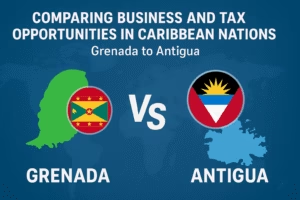
St. Kitts and Nevis is a strong fit if you value programme history, processing speed, and a passport backed by a four-decade track record, and if you do not need the specific commercial features of alternatives — for example, Grenada’s E-2 treaty access to the United States. The best choice always depends on your own objectives around mobility, family planning, business expansion, and reputational comfort.
If those priorities line up, the St Kitts passport remains, in 2026, about as close to a benchmark as this industry offers.