ENGLISH
  Arabic
 Persian


For high-net-worth individuals weighing a second passport, St. Kitts and Nevis remains the benchmark against which every other Caribbean programme is measured. Launched in 1984, it is the world’s oldest citizenship-by-investment (CBI) programme, and after four decades of continuous operation it still commands a reputation for stability, banking acceptance and passport defensibility that newer schemes cannot easily match.
This guide sets out what the St. Kitts and Nevis citizenship by investment programme costs in 2026, how the process works, and who it suits — so you can decide whether it belongs on your shortlist.
Why investors choose St. Kitts and Nevis
A St. Kitts and Nevis passport delivers visa-free or visa-on-arrival access to more than 140 countries, including the United Kingdom, the Schengen Area and Singapore. Citizenship is permanent and hereditary, passing to future generations, and there is no requirement ever to live in or even visit the islands to hold or maintain it.
The tax profile is equally compelling. St. Kitts and Nevis levies no personal income tax, no inheritance tax and no wealth tax on its citizens — a structure that appeals to families planning across borders and generations. Combined with a stable parliamentary democracy and Commonwealth membership, this is why many advisors treat St. Kitts as the Caribbean default for investors who prioritise credibility over the lowest possible entry price.

Investment routes and 2026 costs
There are two principal ways to qualify, and the right one depends on whether your goal is a clean citizenship file or an actual asset position.
- Sustainable Island State Contribution (SISC). This non-refundable donation to the national fund is the most straightforward route and the one most single applicants and families choose. The minimum contribution is USD 250,000for a main applicant or a family of up to four. Additional dependants are charged USD 25,000 each (under 18) or USD 50,000 each (18 and over). The Public Benefit Option (PBO) now mirrors this same pricing structure.
- Approved real estate. Investors who prefer a tangible asset can invest from USD 325,000in a government-approved development, such as shares in a resort or a condominium unit. Property must be held for a mandatory seven-year period before resale, so it should be treated as a medium-term hold rather than a quick flip. A private single-family dwelling route is also available from USD 600,000.
Approved real estate investments can also generate rental yield of roughly 3–5% per year, depending on the property and management, offering a partial return alongside the citizenship benefit.
Due diligence and government fees sit on top of these figures. As a guide, an all-in single application on the SISC route typically lands near USD 262,750, with a family of four closer to USD 275,600.
How long does it take?
The Citizenship by Investment Unit (CIU) generally processes a complete application within four to six months — among the fastest turnaround times in the Caribbean. Actual timelines depend on the complexity of the file, the completeness of documentation and interview scheduling, which is now a mandatory step for all applicants.
For applicants who need to move faster, an accelerated due-diligence option can shorten the standard four-to-six-month timeline further. This puts St. Kitts and Nevis well ahead of programmes that can take eight to ten months or longer — a meaningful advantage for anyone building a time-sensitive Plan B.

Who qualifies?
The main applicant must be at least 18, be of good character and pass rigorous due diligence. The programme is known for its strict vetting, which is precisely what preserves the passport’s value. Eligible dependants include a spouse, children (with the qualifying age for dependent children now extended to under 30), and dependent parents or grandparents aged 55 and above. Applicants with unresolved visa refusals, criminal records or recent bankruptcies are generally disqualified.
What changed in 2026
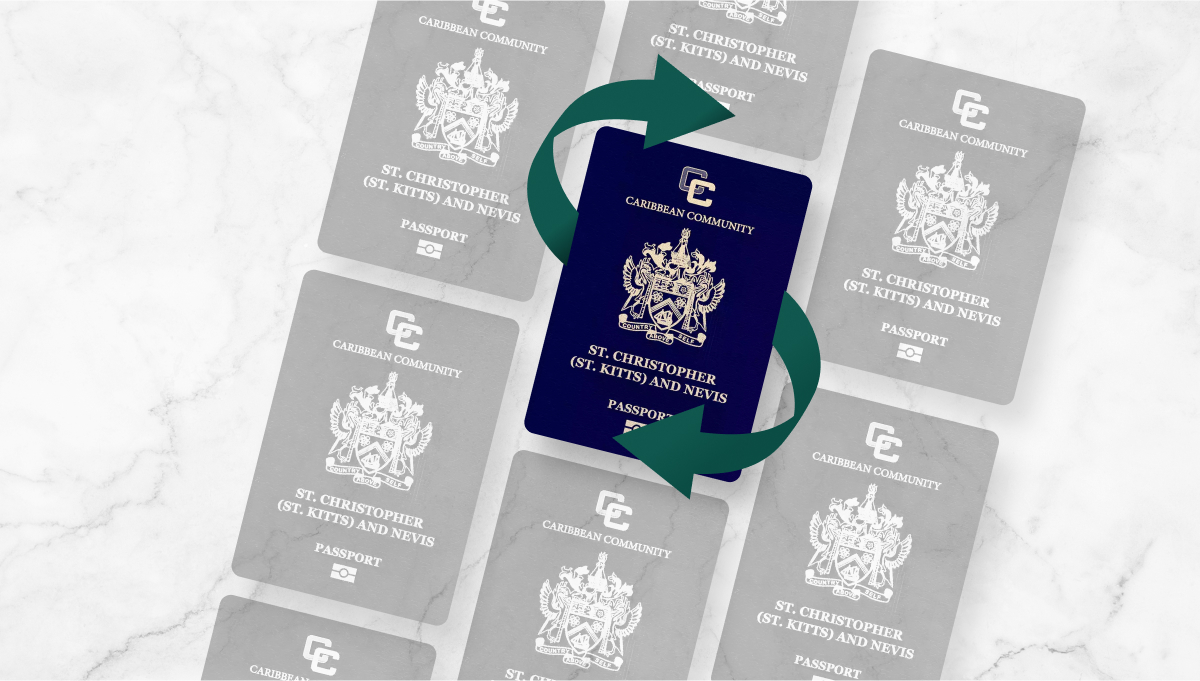
Prospective applicants should be aware of two recent reforms. First, St. Kitts and Nevis introduced mandatory biometric enrolment in 2026, requiring both new and existing CBI citizens to register biometric data and transition to a modernised e-passport. Second, the programme has moved toward a genuine-link model, reinforcing the integrity that underpins its long-standing reputation. These changes strengthen — rather than dilute — the programme’s premium positioning.
Approved biometric collection centres are operating both in St. Kitts and Nevis and in select overseas locations, including the UAE — making it straightforward for Dubai-based applicants to complete this step without traveling to the islands.
Is St. Kitts and Nevis right for you?
If your priorities are long-term passport strength, wide banking acceptance and a reputable, well-governed programme, St. Kitts and Nevis is a natural first choice — even though it sits at the premium end of Caribbean pricing. If absolute lowest cost is the deciding factor, a comparison with Dominica or Grenada may be worthwhile.
The most important decision, however, is choosing the right authorised agent. Because applications must be submitted through a government-approved agent, working with an experienced advisor ensures your file is prepared correctly the first time and that you avoid hidden markups.
Carte Blanche is a government-authorised sub marketing agent for the St. Kitts and Nevis Citizenship by Investment programme, guiding clients from initial assessment through to approval with full due diligence support and transparent pricing. To find out whether you qualify, book a free consultation with our Dubai-based team.
St. Kitts and Nevis is the stronger choice if you value programme history and processing speed over specific commercial features found elsewhere — for example, Grenada’s E-2 treaty access to the United States, which is unique to that programme.
Figures reflect published programme requirements as of 2026 and are subject to change by the Citizenship by Investment Unit. This article is for general information and does not constitute legal advice.